
No, Circulating Document Does Not Come From Ministry Of Basic and Secondary Education
FALSE: The document circulating on social media purportedly from the Ministry of Basic and Secondary Education is not authentic and does not reflect official Ministry policies or initiatives.
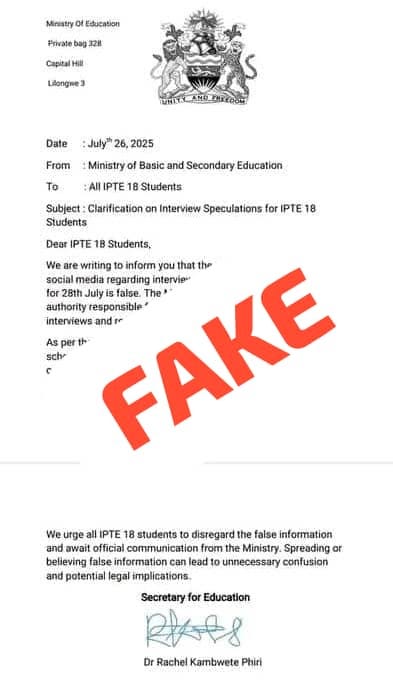
A document claiming to outline new policies and initiatives from Malawi's Ministry of Basic and Secondary Education has been circulating widely on social media platforms, with many users sharing and commenting on its purported contents as if they were official government policy, writes Tionge Hara.
The document, which has appeared across Facebook, WhatsApp groups, and other social media channels, presents what appears to be formatted government communication, complete with official-looking headers and policy language that has led many to believe it represents legitimate ministry announcements.
The widespread sharing of the document has generated significant discussion among parents, educators, and education stakeholders who are interpreting the contents as official government direction on education matters.
But is this document authentic, and does it actually represent official Ministry of Basic and Secondary Education policies?
Methodology
This fact-check investigated the authenticity of the circulating document by directly contacting the Ministry of Basic and Secondary Education to verify its origin and contents.
We examined the document's formatting, language, and distribution channels and sought official confirmation from the ministry's designated spokesperson regarding the document's legitimacy.
What the Ministry says
The Ministry of Basic and Secondary Education has categorically denied the authenticity of the circulating document and confirmed it does not reflect any official Ministry policies or initiatives.
Christopher Banda, spokesperson for the Ministry of Basic and Secondary Education, provided a clear statement regarding the document's status when contacted for verification.
"The Ministry does not endorse or recognise the document," Banda stated unequivocally.
"The document's contents are not reflective of the Ministry's policies or initiatives."
Banda emphasized that the ministry has not authorized the creation or distribution of the document in question, and that its contents should not be interpreted as representing official government education policy.
Official guidance
The Ministry spokesperson issued clear guidance for the public regarding how to handle the circulating document and similar situations in the future.
"The public is advised to disregard the document and seek information from official Ministry channels," Banda said, emphasizing the importance of verification before accepting documents as authentic government communications.
The ministry's position reflects growing concerns about misinformation and unauthorized documents circulating on social media platforms, particularly those that appear to carry official government authority but lack proper verification and authentication.
The misinformation challenge
The incident highlights broader challenges facing government institutions in the digital age, where unofficial documents can quickly gain traction on social media and be mistaken for legitimate government communications.
Social media platforms' rapid information-sharing capabilities mean that unauthorised documents can reach thousands of users within hours, often being shared and discussed as if they were verified official communications before authorities have the opportunity to respond.
The formatting and presentation of the fake document appear to have been sophisticated enough to convince many users of its authenticity, demonstrating the evolving sophistication of misinformation campaigns that target government institutions.
Verification importance
The ministry's response underscores the critical importance of information verification, particularly when documents claim to represent official government policy or announcements.
Government communications typically follow established protocols for release and distribution, including official letterheads, proper authorisation signatures, and distribution through verified official channels such as government websites, press releases, or authorised media briefings.
Citizens and stakeholders are encouraged to verify the authenticity of any document claiming government origin by cross-referencing with official ministry websites, contacting ministry officials directly, or waiting for official confirmation through established government communication channels.
Official channels
For accurate and reliable information about Ministry of Basic and Secondary Education policies and initiatives, the public is advised to consult official sources, including:
The Ministry's official website and social media accounts
Press releases distributed through official government channels
Direct communication with Ministry offices
Authorised government media briefings and announcements
Official government gazette publications
The Ministry maintains established communication protocols designed to ensure that authentic policy announcements reach the public through verified and accountable channels.
Broader implications
This incident reflects a pattern of misinformation targeting government institutions in Malawi and across the region, where unauthorised documents are created and distributed to create confusion or advance particular agendas.
The sophisticated presentation of fake government documents poses challenges for both institutions and citizens, requiring increased vigilance and verification processes to distinguish authentic communications from misinformation.
Educational institutions, parents, and stakeholders in the education sector are particularly vulnerable to such misinformation, as they rely on accurate government communication to make informed decisions about educational policies and practices.
Ministry recommendations
The Ministry of Basic and Secondary Education has advised the public to exercise caution when encountering documents that claim government origin, particularly those circulating through unofficial channels.
Key recommendations include:
Verifying document authenticity through official Ministry channels before sharing or acting on contents
Being skeptical of documents that lack proper official formatting, signatures, or distribution protocols
Reporting suspected fake documents to relevant authorities
Educating others about the importance of verification before sharing government-related content on social media
Verdict
FALSE: The document circulating on social media purportedly from the Ministry of Basic and Secondary Education is not authentic and does not reflect official Ministry policies or initiatives.
The Ministry has confirmed the document is unauthorised and advises the public to disregard its contents.
This case demonstrates the critical importance of verifying information before accepting or sharing documents that claim government authority.
Citizens should rely on official ministry channels for accurate information about education policies and remain vigilant against misinformation campaigns targeting government institutions.