
Kagame Warns World Is Underestimating Genocide-Era Militia Threat From Congo
Kagame criticized what he described as a pattern in which Congolese President Félix Tshisekedi and his officials are allowed to act irresponsibly while Rwanda is pressured by outside powers.
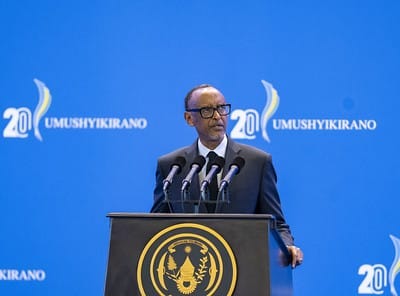
KIGALI, Rwanda — President Paul Kagame on Thursday accused the international community of downplaying the danger posed by a militia rooted in Rwanda’s 1994 genocide, warning that failure to confront the group risks prolonging instability across the Great Lakes region, writes AfricaBrief Reporter.
Speaking as he opened the 20th edition of Rwanda’s National Dialogue, known as Umushyikirano, at the Kigali Convention Centre, Kagame said the Democratic Forces for the Liberation of Rwanda (FDLR) remains a serious security threat despite claims that the group is weakened and aging.
The annual forum brings together citizens and leaders to assess national progress and agree on solutions to issues affecting communities.
The FDLR is made up largely of remnants of those responsible for the Genocide against the Tutsi, in which more than one million people were killed in roughly 100 days in 1994.
The killings ended after the then-rebel Rwanda Patriotic Front, led by Kagame, defeated the genocidal forces, many of whom fled into what is now the Democratic Republic of Congo.
Kagame said those remnants reorganized in eastern Congo and continue to operate with the backing of the Congolese government, with the aim of destabilizing Rwanda and removing its leadership.
Rwanda’s concern, he said, extends beyond military capability to ideology.
“What they are trying to say is: ‘How can you have such a big problem when some of them are old, even 90 years old?’” Kagame said.
“Even if they are 90, they are still there. And if they have children whom they train and fill with this ideology, and those children become militias or fighters within the FDLR, then their age becomes irrelevant.”
He said the group continues to spread genocide ideology in the region, seeking to complete what it began in Rwanda more than three decades ago.
Kagame rejected accusations that Rwanda is responsible for the conflict in eastern Congo, urging critics to verify the facts.
He said Rwanda has put defensive measures in place to counter the threat posed by the DRC-based militia and that his government has a duty to protect its citizens.
“For protecting our people, that one we shall. There is no question about it,” he said.
The president also described what he called constant pressure and threats from external actors over the security situation in Congo.
“The amount of threats we come under on a daily basis … sometimes you feel choked,” Kagame said, adding that Rwanda cannot be blamed for problems it did not create.
“You can’t create problems for me, at the same time come and blame me for these problems, and then start threatening me,” he said.
Kagame criticized what he described as a pattern in which Congolese President Félix Tshisekedi and his officials are allowed to act irresponsibly while Rwanda is pressured by outside powers.
“And I tell them, don’t you realize that by doing that you are actually emboldening this person not to find a solution to their problem?” he said.
He said Rwanda cannot accept responsibility for the challenges facing the DRC and urged Congo’s leadership to confront its own governance and security failures.
“They have responsibilities and must not transfer them to Rwanda. We are not responsible for Congo,” Kagame said.
Addressing allegations that Rwanda is involved in eastern Congo for minerals or territorial expansion, Kagame said such claims are meant to distract from the continued presence of genocide-linked forces operating from Congolese territory.
“They invent many reasons, but they avoid the main issue,” he said.
Kagame also faulted the United Nations for failing to find a lasting solution to the protracted conflict in eastern Congo, arguing that international efforts have not addressed the root causes of the violence.
The Umushyikirano dialogue comes amid heightened regional tensions, with Rwanda and the DRC trading accusations over insecurity in eastern Congo — and Kigali signaling that it intends to act decisively against what it views as an existential threat.