
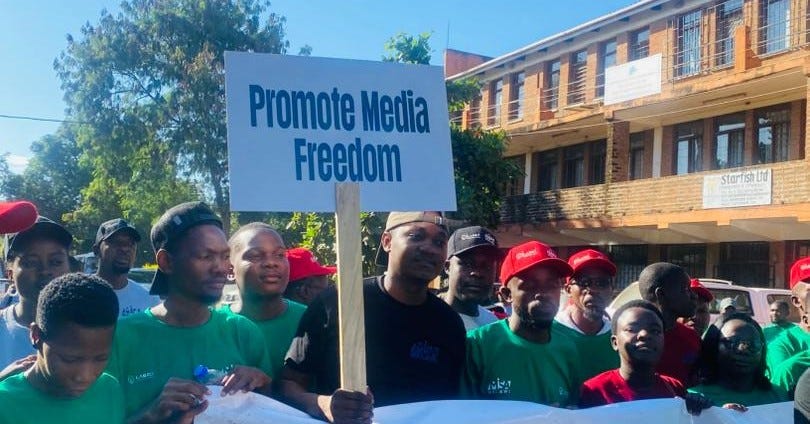
LILONGWE, Malawi—On 3rd May, Malawi journalists gathered in Salima for the World Press Freedom Day celebrations under the global theme: “shaping a future of peace.” We reflected on the ideals of a free press and how it contributes to peace and development, writes Phillip Chinkhokwe.
Our celebrations were marked by a solidarity march, a panel discussion, and a media gala where outstanding journalistic work was recognized with awards.
In the past few years, we witnessed high-level engagements between the State and the media, through Presidential breakfasts at State residences as part of these celebrations.
This year, it was not the case, but the State still showed up. The President released a statement in solidarity and support for press freedom, while the Minister of Information was the guest of Honour at the awards ceremony.
Such high-profile engagements and gestures frame a picture of openness and dialogue about media matters. However, some critics have pointed out that the political proximity associated with such signature events is merely symbolic.
Behind the curtains stand the Peeping Toms listening from every corner of an independent newsroom. Moreover, the question is, can the fourth estate effectively hold power to account while simultaneously breaking bread with it?
There is progress, yes, in the boardrooms. In practice, we have to put a lot on the ground. Censorship, intimidation, and increasing SLAPPs continue to affect the work of journalists.
However, in this article, I am reflecting on something different about press freedom and journalists: can journalism truly thrive when journalists themselves are struggling to survive?
This critical area is often overlooked. I have heard of journalists being called beggars at Parliament. I have heard of journalists threatening not to publish a story because the news source did not provide an incentive. I have heard of journalists creating relations with PR officials only to be considered for event coverage, just to get something out of it.
What does this mean? Media freedom is not only about the absence of state or external control, or about the quality of journalism. It is also about the presence of conditions that allow journalism to be practiced with integrity and dignity.
During a panel discussion at the celebrations in Salima, one contributor caught my attention: “We talk a lot about press freedom and safety of journalists, how about the economic safety of the same?” The entire room erupted in claps. Someone raised a critical point for discussion.
Across Malawi’s media landscape, from the newsrooms that boast of large followership in the cities to community radios, journalists are working under conditions that barely sustain their livelihood. Several issues define the harsh realities, top of the list is low pay.
While this case is different from one media house to another, in general, journalists, mostly junior reporters are underpaid. There is another painful reality: journalists working without contracts, salaries paid in instalments, and little or no safety nets. These are not just labour issues; we should address these as journalists’ safety issues.
A press that is free by legal checkboxes but languishing economically is not truly free. It is vulnerable and exposed. We must measure Media freedom by the conditions under which journalism is produced.
It has been a year since Davie Mchinga petitioned the Malawi Human Rights Commission (MHRC) about the working conditions and low wages in media houses.
MHRC, as per media reports, has made progress in its investigations. Obviously, this investigation will validate Mchinga’s claims and put forward recommendations. MHRC’s mandate is not to enforce labour laws, so who will take up these recommendations to face the bulldogs?
A journalist who is constantly worried about rent, transport, or basic survival is placed in a position of vulnerability. Many journalists have financial insecurities that contribute quietly to unethical conduct, ultimately eroding professional gatekeeping and independence.
In many circumstances, this is what is creating openings for undue influence. In such an environment, the line between professional judgment and survival strategy becomes dangerously thin, resulting in journalists no longer writing for the profession but for survival.
This conversation becomes uncomfortable at this level. Chipondamthengo (incentive to publish) is not only a Malawi, when you start this debate, you must also come with clean hands.
We rightly speak about the physical safety, including protection from harassment, intimidation, and arrests. What about economic safety?
What does it mean to tell a journalist to “be brave” when the same system cannot guarantee them a living wage? This is where the conversation about safety should include the structural realities within the newsrooms themselves. But who will face the bulldogs head-on?
Mchinga questions whether media owners particularly in privately owned and community media houses comply with labour laws, including those on fair pay. Regardless, journalists in those newsrooms still meet deadlines, break news, and expose realities that shock the public.
We say the media as a fourth estate strengthens democracy, but the truth is simple: a free press is only as strong as the people who make it possible.
If journalists are not economically secure, the journalism we depend on cannot be secure either. It cannot be the cornerstone for accountability, let alone providing thorough checks and balances, and professional gatekeeping.
Media bodies like the Media Council of Malawi expect the best from journalists, while they do this, they should also help in engaging Media owners to discuss journalists’ welfare.
It is also high time Journalists in Malawi collaborate to strengthen the Journalists Union of Malawi (JUMA) to be their collective voice on welfare, enforce labour standards and policies that value journalists.
Thanks for these valuable insights.