

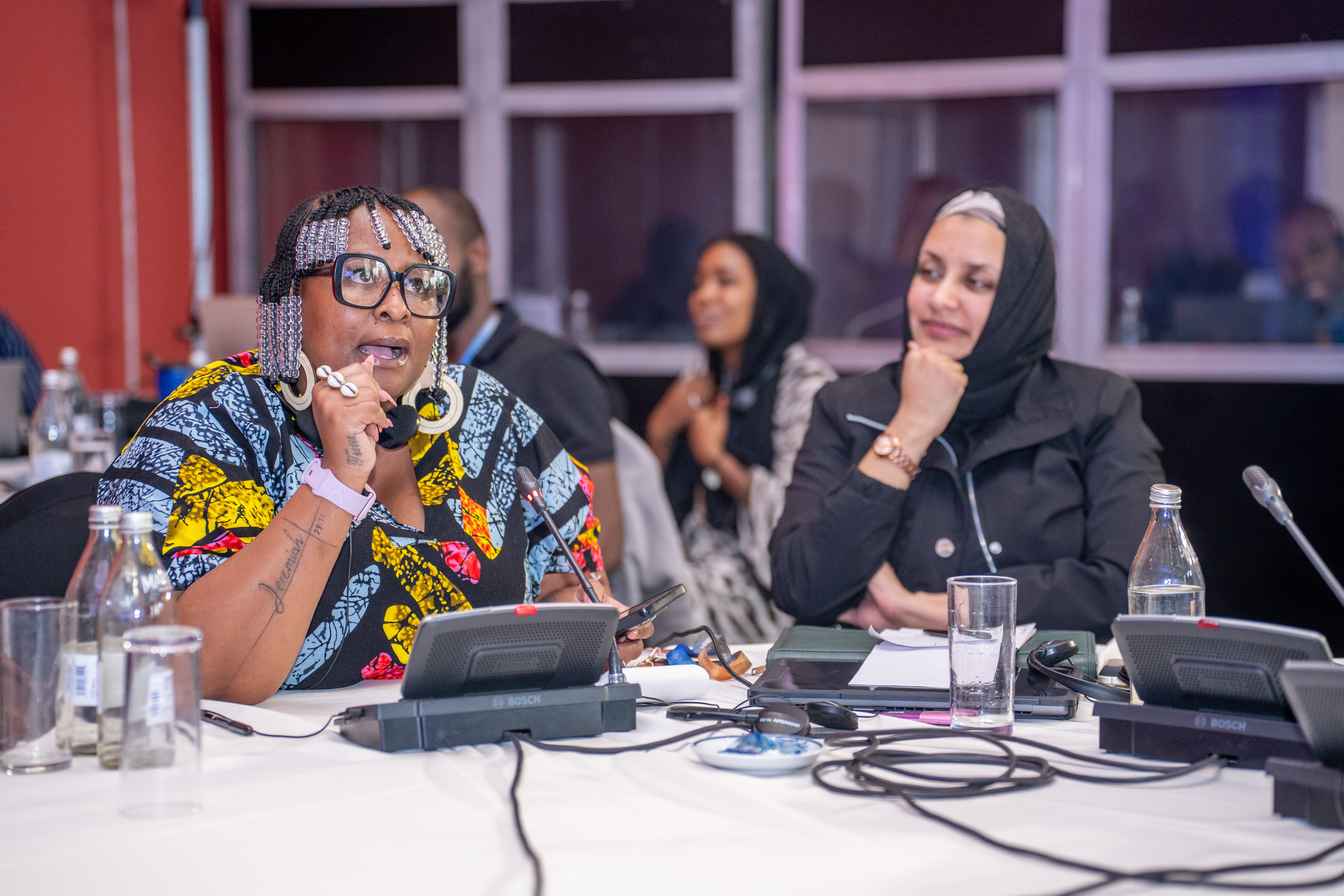
Nairobi, Kenya — Legal expert Lyla Latiff delivered a hard-hitting presentation on the opening day of the AFRODAD Media Initiative (AFROMEDI VI), urging African governments to radically expand domestic revenue mobilisation by taxing untapped resources in the digital economy and high seas infrastructure, rather than relying on expensive foreign debt, writes Winston Mwale.
Speaking during the session on the Legal Review of Contractual Agreements in African Sovereign Debt on 27 May 2026, Latiff dissected systemic fiscal barriers facing the continent and proposed bold legal and policy reforms.
Her address to journalists from 29 African countries highlighted how outdated tax rules, unclaimed maritime rights, and corporate loopholes perpetuate debt traps and undermine sovereignty.
“Data is worth a trillion US dollars. Nobody taxes data,” Latiff declared at the start of her presentation.
She pointed to the concentration of power in a few US-based cloud computing companies that hold vast amounts of African personal and commercial data.
“The cloud computing companies that hold people’s data, there are only a few in the world, and they are all in the United States. They all have our data.”
Latiff explained that governments struggle to monetise this data because it does not meet the traditional “permanent establishment” threshold required for taxation under current international rules.
This creates a massive tax deficit, pushing countries like Kenya into high-interest borrowing.
“We end up having a tax deficit, which means we then have to now borrow... And we borrow a debt, a loan, at a high interest rate.”
She contrasted interest rates starkly: “The loan that the IMF will give Germany will come at maybe 2% interest rate. But the loan that they will give to Kenya will come to, what, 11%?”
This disparity, she argued, stems from risk perceptions by credit rating agencies that label African nations as high-risk, making debt more expensive and unsustainable.
With Kenya’s tax-to-GDP ratio at 15.8%, Uganda at 11%, and Tanzania at 10% — well below the African average of 16.1% and the OECD’s 33.3% — Latiff stressed the urgency of finding new revenue streams.
She noted that most African tax revenue comes from regressive sources like Pay As You Earn (PAYE), VAT, excise duties, and customs, while corporate taxation offers limited gains due to generous incentives.
Kenya alone has foregone revenue equivalent to 3.3% of GDP — around 510 billion Shillings — through tax incentives granted mainly to foreign companies.
“This is a huge amount,” she said, especially when public debt burdens hover near 12 trillion Kenyan shillings.
The Digital Data Goldmine Left Untapped
Latiff devoted significant time to the digital economy, describing data as a modern resource more valuable than many traditional commodities.
She cited valuations showing a single male doctor without children in the US has personal data worth about $4,000, while the African average stands at just $283.
“Why is my data... worth $283, and the guy in the US has been given a value of $4,000? These are things we need to think about because it’s a trick,” she remarked, promising further explanation on valuation methodologies that systematically undervalue African data.
She illustrated data flows using Kenya’s geography. An email sent from Nairobi to Singapore travels via submarine cables crossing the Indian Ocean, high seas, and intermediary countries like Somalia, Oman, and India.
These cables, once dominated by telecom firms, are now largely owned by private giants such as Google and Amazon.
Under the United Nations Convention on the Law of the Sea (UNCLOS), coastal states control territorial seas up to 12 nautical miles and exclusive economic zones (EEZs) up to 200 nautical miles.
Latiff questioned why African countries fail to charge landing or user fees when these cables pass through their waters.
“Is any African country charging these companies landing fees? This is domestic revenue mobilisation lost,” she stated.
In contrast, Malta charges Google and Amazon €10,000 for using its economic zone and territorial sea.
Latiff proposed a modest African equivalent: $12,000 annually per company.
“Even if it’s $12,000, it is still income for the country. We should at least maybe pay off some essential medication in the public hospital.”
She called for journalists to advocate for an expanded definition of “permanent establishment” in tax models, including the UN Tax Model, to cover automated digital services.
This would force multinationals to provide country-by-country reporting, revealing exact revenues generated from African users — for instance, from two million Kenyans on a single platform.
“If it was maybe $1 billion... then you put a tax of maybe 30% on that and you generate revenue,” Latiff explained. With Africa rapidly digitalising, failing to update legal frameworks now would leave the continent perpetually disadvantaged.
High Seas as the New Infrastructure Economy
Latiff expanded her vision to what she termed the “infrastructure economy” — focusing on oceans beyond traditional sectors.
She mapped Kenya’s position: 12 nautical miles of territorial sea granting full jurisdiction, followed by 200 nautical miles of EEZ for fishing, mining, and oil exploration.
Beyond that lies the high seas — “a common heritage for mankind” and effectively a no-man’s land.
Submarine cables now crisscross these areas, increasingly controlled by private tech firms.
The International Seabed Authority oversees deep-sea mining, an industry potentially worth $20 trillion, yet dominated by just 13 companies, mostly European.
“Whatever they’re doing here, they’re using our economic zone and our territorial sea to access our ports. We’re not charging them landing fees or user fees,” Latiff lamented.
She highlighted the Cook Islands near New Zealand, which could generate $10 trillion from high seas activities despite its tiny size.
“Now imagine for Nigeria, for Ghana, for Tanzania, for Kenya, how much more can we generate? Because we have more economic activity here.”
The Indian Ocean, Red Sea, and Suez Canal routes amplify potential for East Africa.
Latiff urged stronger regulation and fee structures, positioning the high seas as a frontier for fiscal sovereignty rather than a free passage for multinationals.
Illicit Financial Flows and Corporate Loopholes
A substantial portion of Latiff’s address tackled illicit financial flows (IFFs), estimated between $50-89 billion annually.
She detailed transfer pricing abuses where multinational companies shift profits through subsidiaries in tax havens like the Cayman Islands or Isle of Man.
Using a hypothetical with multiple subsidiaries, she explained how inflated “management fees” or “consultancy services” for artificial intelligence or mining advice drain taxable income.
“You come up to your net profit, which would be basically nothing. And that is what is taxed.”
In the mining sector, companies deploy drones and sensors for low-cost exploration — perhaps $15,000 for equipment and $25,000 for software — yet claim exploration costs of $200 million.
“You now tell the government the exploration cost me $200 million... because the government is not going to come and check.”
Latiff warned of emerging AI-enabled threats, citing a 2024 case in China where two individuals used deepfake technology from Instagram selfies to create fake digital IDs and redirect tax refunds, earning $76 million.
“Think about 60, 70, 80, 100 other individuals doing this. That’s a new form of illicit financial flows.”
She cautioned journalists about sharing personal data online, as facial recognition and even thumbprints can be harvested for fraud, especially in digital-heavy jurisdictions.
Debt Contracts: Legal Vulnerabilities and Colonial Legacies
Latiff’s session framed these issues within broader contractual problems in African sovereign debt.
Many agreements are governed by New York or London law, include sovereign immunity waivers, confidentiality clauses, and resource-backed collateral arrangements that risk ceding control over national assets.
She described the current debt system as carrying a “colonial mindset” and “colonial bottleneck” through bilateral investment treaties that lock countries into unfavourable terms.
“Why do our governments continuously relying on conventional debt?” Latiff asked.
She pointed to alternatives like Sukuk financing from Kuwait, Saudi Arabia, and the UAE, which involve shared equity rather than interest. Nigeria has successfully used similar non-interest models for infrastructure.
“Why can’t we do the same in other countries?”
Call to Action for Journalists and Policymakers
Throughout her presentation, Latiff repeatedly addressed the 45 journalists gathered, positioning them as key actors in the fight for fiscal justice.
“You need to fight for a broader definition of what constitutes permanent establishment... We need the definition of permanent establishment to change to recognize all types.”
She stressed the need for country-by-country reporting so governments can accurately tax digital revenues.
“Because we’re not thinking about today only, we’re thinking about the future. And we are all moving towards digitalisation.”
Latiff concluded by linking stronger domestic revenue mobilisation (DRM) to reduced debt dependence and greater fiscal sovereignty.
“If you think about it, unless we learn how to now think about ways in which we can mobilise more domestic revenue, we will never solve the debt issue.”
Her remarks aligned with AFROMEDI VI’s theme of partnering with media to advance socio-economic justice and Africa’s common position on debt.
By equipping journalists with these insights, the three-day event from 27 to 29 May 2026 seeks to foster investigative reporting that exposes loopholes and promotes policy reforms.
Implications for Africa’s Future
Latiff’s analysis reveals a continent sitting atop enormous untapped wealth while trapped in cycles of borrowing. Implementing her proposals — from maritime user fees and digital taxation to closing transfer pricing gaps — could generate billions in additional revenue.
For Kenya, hosting the event, these ideas carry immediate relevance amid ongoing debt servicing pressures that crowd out spending on health, education, and infrastructure.
Across Africa, where 31 countries spend more on debt than healthcare, shifting the narrative from debt dependence to resource sovereignty is critical.
Yet challenges abound. Revenue authorities often lack capacity for complex audits involving AI, drones, or high-seas activities.
Global tax negotiations remain skewed toward developed nations, though the UN Framework Convention offers a platform for reform.
Political will is another hurdle, as incentives and exemptions frequently benefit powerful interests.
Nevertheless, Latiff’s message was one of empowerment: African nations possess the legal tools under UNCLOS and evolving tax models to assert rights.
Her presentation also carried a warning. Without urgent action, digitalisation and ocean economy growth will further enrich external players while leaving Africans “at the short end of the stick.”
As AFROMEDI VI continues with sessions on budget analysis, extractive industries, and feminist perspectives on debt, Latiff’s opening address has set a provocative tone.
Journalists left the session with concrete story leads — from submarine cable fees in the Indian Ocean to deepfake tax fraud — and a renewed mandate to scrutinise fiscal policies.
In an era where data flows faster than oceans and debt compounds silently, Lyla Latiff has challenged Africa’s media and policymakers to rewrite the rules of the game.
The coming days of the initiative will determine whether these ideas translate into widespread reporting that pressures governments toward genuine economic justice.