

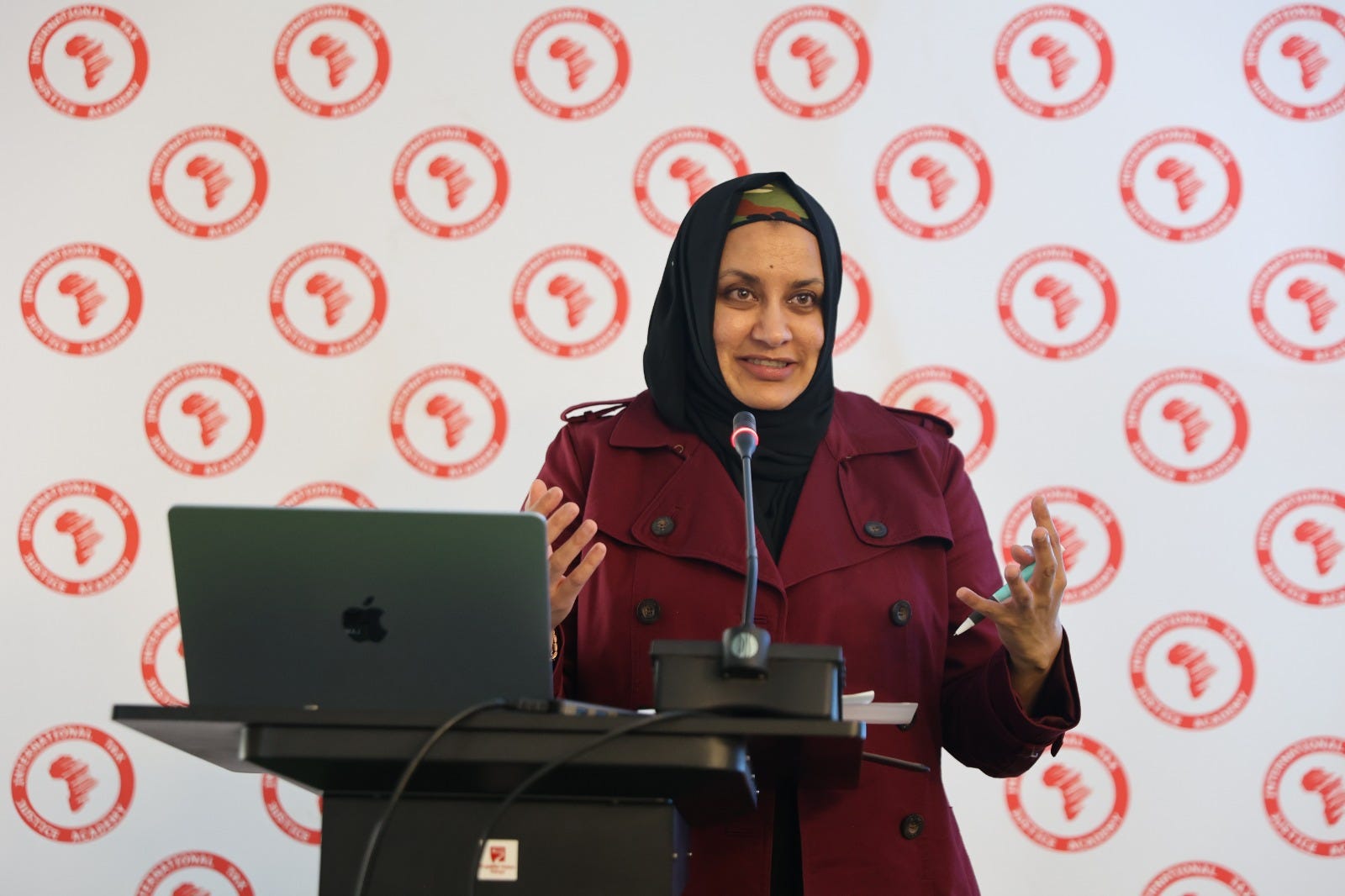
Nairobi, Kenya — Pan-African lawyer, academic and policy strategist Lyla Latif delivered a powerful keynote address on Monday, June 15, 2026, urging participants at the International Tax Justice Academy (ITJA) Intermediate Course to centre language, artificial intelligence and the international financial architecture in the fight for tax justice across Africa and the Global South, writes Winston Mwale.
In a wide-ranging speech that blended sharp critique, historical context and forward-looking analysis, Latif challenged civil society actors and media practitioners to move beyond conventional tax debates and interrogate the structures shaping public finance in an era of rapid digital transformation.
Her address set the tone for the multi-day workshop organised in Nairobi, emphasising that tax justice is not merely a technical issue but a profound question of power, sovereignty and equity.
Latif, who serves as Board Chair of the Tax Justice Network and has advised governments, trained tax administrators across continents, and contributed to legislative reforms on international taxation, began by expressing gratitude for the opportunity to speak.
She acknowledged the rich curriculum of the ITJA, which covers topics from the political economy of taxation to domestic resource mobilisation, illicit financial flows and health taxes.
Yet she pushed participants to view these through an emerging lens — one that accounts for artificial intelligence, algorithmic bias, digital economies and decolonial perspectives.
“Anybody can speak about the importance of tax justice going forward,” Latif noted.
“But what I want to speak about are three important things... these three elements must form the substance of what you’re going to be discussing when you think about tax justice as you move forward.”
Those three pillars — language, artificial intelligence, and the international financial architecture — formed the core of her message, woven throughout nearly 30 minutes of remarks that repeatedly circled back to questions of power, visibility and African agency.
Political Economy in the Age of AI and Digitalisation
Latif opened by highlighting the political economy of taxation, stressing that it is fundamentally about power and economic relationships designed by politics.
She urged deeper engagement not just with traditional frameworks but with how AI, digitalisation and algorithmic biases are reshaping tax policy discussions, including gender dimensions.
She referenced the UN Framework Convention on International Tax Cooperation, noting its potential impact from entrenched political-economic relationships.
Participants should master the key characteristics of workshop topics from expert facilitators but also interrogate them in the current transformative context.
“Political economy is about power,” she said. “And the question about politics sits with an international financial architecture.”
Latif drew a sharp distinction between financial and fiscal architecture.
The former — treaties, institutions like the IMF and World Bank — represents the visible structures, while the fiscal foundation comprises laws, regulations, norms and principles rooted in fiscal sociology.
She questioned how these are integrated into global discussions, particularly around digital business models.
Current concerns focus narrowly on taxing entities like Amazon, e-commerce platforms, or Netflix subscriptions.
But Latif pushed further: How do we tax robots? How do we tax AI agents performing work traditionally done by humans?
These questions must inform the political economy of taxation in Africa’s transformation phase.
Turning to domestic resource mobilisation (DRM), Latif affirmed its importance while critiquing over-reliance on existing sources such as VAT, excise duties and PAYE, which suffer from revenue leakage.
She called for innovative financing models leveraging digitalisation and AI, warning of a “post-apocalyptic world” where traditional labour-based taxation erodes as automation advances.
Without salaries from human labour, pay-as-you-earn systems collapse. States must redesign DRM policies around transformative technologies to capture new value streams.
Tax-Related Illicit Financial Flows and Visibility
Latif expressed appreciation for the workshop’s focus on tax-related illicit financial flows (IFFs), contrasting it with dominant narratives around criminal aspects like money laundering and corruption.
She highlighted overlooked areas in commodity value chains — agriculture, trade, extractives and especially beneficiation stages — where transfer mispricing, abusive profit shifting and trade mis-invoicing persist.
A key theme was visibility versus invisibility in taxation. Formal employment income is highly visible to the state, but value addition in middle sectors of commodity chains often remains invisible.
New DRM models must address this gap.
She linked health taxes to AI, pointing to algorithmic biases in health apps that diagnose diseases or predict outcomes based on user behaviour and data collection.
Such apps generate revenue while embedding biases that affect tax design, particularly for informal and gendered labour.
Latif illustrated value creation in the digital economy using a simple example of adding design value to a basic product.
In traditional settings, a foreign company needs a physical “permanent establishment” (often transcribed as “talent establishment” in the speech) to be taxed locally.
But digital services allow value creation without physical presence — from Tunisia or elsewhere — challenging outdated concepts.
Data, algorithms and user participation constitute new forms of value creation that must be capitalised for domestic revenue mobilisation.
African countries need to frame these in tax policy negotiations to generate more resources.
The Three Crucial Perspectives on Tax Justice
Latif distilled tax justice into three critical lenses: language, artificial intelligence and the international financial architecture (IFA).
**Language as a Site of Struggle:** Vague language in international negotiations invisibilises fair allocation of taxing rights.
Colonial imprints in legislation must be identified and decolonised. Participants should scrutinise terms in health taxes, IFFs in extractives, tax treaties and policies.
“Who wrote the words?” Latif asked repeatedly. Terms like “permanent establishment,” “jurisdiction” (with nuances between English and French legal traditions), tobacco taxes or “harmful tax practices” carry underlying assumptions, often from OECD frameworks rather than African priorities like Agenda 2063.
Language influences public money allocation. Corporate-framed budgets prioritise return-on-investment sectors over social services.
Illicit financial flows terminology evolved from earlier concepts like capital flight, with Latif arguing IFFs as the broader “grandmother” encompassing base erosion and profit shifting (BEPS) as a narrower “grandchild.”
African-led definitions must prevail over external ones.
DRM rhetoric in documents like Kenya’s Vision 2030 raises questions: Does it squeeze citizens via higher VAT or excise, or target outward drains through multinational practices and special economic zones?
Wealth taxation remains underexplored.
Artificial Intelligence and Automation
Latif warned of an automated future without human labour, necessitating new tax language.
AI-designed apps embed biases, particularly against informal sector workers, domestic workers and women.
Backend technologies originate from Silicon Valley, Singapore, China and Germany — not Africa — potentially embedding extraction biases.
Data valuation exemplifies inequities: A single male doctor’s data in the US valued at $5,000 annually versus $263 for an African, highlighting geographic pricing disparities.
With data worth trillions globally, it must be treated as taxable value creation at source.
User participation on digital platforms in countries like Kenya should generate reportable revenue for taxation.
Data centres illustrate injustices: A centre in Arizona serving 60-80 countries claims permanent establishment only locally, benefiting from subsidised power while network effects span continents. Such subsidies burden locals — is this justice?
International Financial Architecture
Everything in tax justice fits within the IFA. Latif questioned reform versus dismantling institutions with colonial undertones, referencing efforts like BRICS alternatives.
“Tax justice is all about who holds the pen,” she declared, asking whether Africans or figures like Elon Musk control the narrative.
She critiqued tax planning in free zones and international financial centres enabling 100% untaxed profit repatriation, designed by external actors.
Hawala Trading and Contextualising Illicit Flows
Latif challenged blanket labelling of informal systems like Hawala trading as illicit.
Practised for centuries, it serves cash economies in rural and informal sectors, especially under sanctions.
In Africa’s context, where informal economies dominate, is it purely IFF or a strategic portfolio? Northern definitions should not dictate African realities.
Broader Implications and Call to Action
Latif’s address painted a holistic picture for the workshop, urging participants to connect topics across levels — from UN conventions to grassroots budget tracking.
She referenced collaborators and examples from Ghana, Tunisia and beyond, emphasising African ownership of language, technology and fiscal policy.
Her decolonial, Pan-African lens aligns with her extensive work: drafting tax laws for UNDP, advising Eswatini’s Revenue Appeals Tribunal, training across continents, and contributing to global debates alongside Nobel laureates.
The ITJA, launched by Tax Justice Network Africa in 2014, continues to build capacity for critical engagement with taxation, equipping CSOs and journalists to advance fair systems.
As Africa grapples with digital economy challenges — base erosion, profit shifting, and ensuring value from data and platforms — Latif’s call resonates deeply.
Revenue losses from digital transactions hinder public services, inequality reduction and sustainable development.
Experts note that traditional physical-presence rules fail against platform economies, cloud computing and AI.
African nations need stronger administrations, integrated tech for compliance, and unified voices in international negotiations.
Latif left participants with probing questions: Whose language dominates budgets and policies? How do we price and tax data generated by Africans? Can we redesign fiscal architectures for justice rather than extraction?
Her speech underscored that true tax justice requires Africans to hold the pen — defining terms, designing algorithms and shaping architectures that serve public good over private extraction.
In the days ahead, workshop sessions will delve deeper, but Latif’s keynote has already framed the urgent stakes.
For CSO actors and media, the task is clear: amplify African perspectives, expose biases, and push for policies that convert digital value into schools, hospitals and inclusive growth.
As one participant might summarise, the conversation has moved from taxing Netflix subscriptions to taxing the robots, data and invisible value chains powering tomorrow’s economies — and ensuring Africa claims its fair share.