

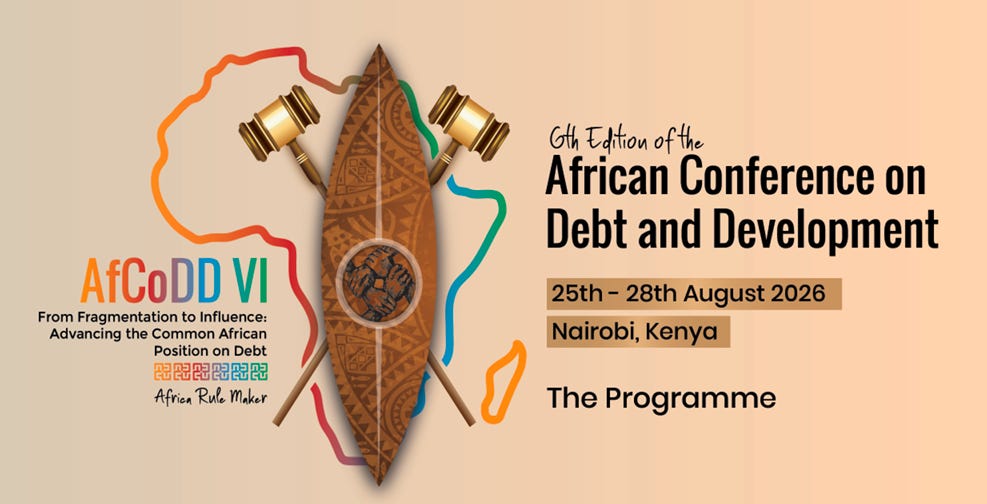
NAIROBI, Kenya — Africa’s debt crisis is entering a decisive political phase this week as governments, lawmakers, civil society groups, academics and development finance experts converge for the sixth African Conference on Debt and Development, with organizers warning that the continent’s failure to act collectively has become almost as dangerous as the debt itself, writes Winston Mwale.
The African Forum and Network on Debt and Development, or AFRODAD, and its partners will hold AfCoDD VI from Aug. 25-28 under the theme “From Fragmentation to Influence: Advancing the Common African Position on Debt.”
The conference comes months after the African Union adopted the Common African Position on Debt in February, creating what organizers describe as a rare opportunity for African countries to move beyond declarations and begin exercising collective power in negotiations over sovereign debt and the global financial system.
But the conference’s own concept note is unusually blunt about the scale of the challenge.
“African countries have for several decades remained ensnared in a deepening debt trap,” the document says, attributing the crisis not only to an international financial system resistant to reform but also to “the continent’s fragmented response to a coordinated crisis that has become as dangerous as the debt crisis itself.”
That diagnosis places the central question of AfCoDD VI beyond the usual debate over whether African countries have borrowed too much or whether creditors should provide relief.
The harder question is whether African governments can finally act as a bloc.
The conference concept note says Africa’s total debt has risen by nearly 170% over the past decade to more than $1.8 trillion, while African countries are increasingly paying external creditors at the expense of domestic investment.
It also says African countries face borrowing costs substantially higher than those of richer economies.
According to figures cited in the concept note from the United Nations Conference on Trade and Development, African bond yields since 2020 have been close to 10%, compared with 2.8% for the United States and about 1.87% for the euro area between 2020 and 2024.
For a continent struggling to finance roads, hospitals, schools, energy systems and industrial development, the implications are stark.
Debt service is no longer simply a matter of accounting.
It is increasingly a question of what governments can afford to spend on their citizens.
The concept note says about 10% of revenue is being consumed by interest payments in 27 African countries, up from nine countries in 2010.
That pressure is at the heart of the conference’s political message.
From declarations to enforcement
The organizers are not presenting AfCoDD VI as another conference for producing communiqués.
The stated objective is to determine how the Common African Position on Debt can become an enforceable political and institutional program.
The concept note says the conference aims to move the CAP “from a statement of continental intent into an actionable and politically consequential programme” by identifying practical implementation pathways, strengthening African solidarity and building a sustained civil society movement capable of holding governments and other stakeholders accountable.
That language is significant.
African leaders have issued common positions on debt before. The problem has rarely been a shortage of declarations.
The problem has been implementation.
The conference therefore intends to identify “concrete, enforceable steps and mechanisms” capable of turning the CAP from a declaration into a program that binds member states and other stakeholders through mutual obligations.
It will also examine how African governments can prevent the CAP from being diluted during individual negotiations with creditors.
The concept note explicitly calls for mechanisms to prevent “selective defection by individual countries or regions” and to address political fragmentation among African states.
That may be the most difficult part of the entire agenda.
Africa is not a single borrower.
Its 55 countries have different levels of indebtedness, different creditors, different economic structures and different relationships with institutions such as the International Monetary Fund, World Bank, China, commercial lenders and bond markets.
A common negotiating position therefore sounds straightforward in principle but is extraordinarily difficult in practice.
AfCoDD VI is designed to confront that problem directly.
One of the first substantive sessions, scheduled for Aug. 26, is titled “From Declaration to Delivery: Building the Institutional Architecture and Mutual Accountability Mechanisms for the Common African Position on Debt.”
The program says the session will examine what it takes to turn the CAP into “a binding, implementable programme” and explore institutional mechanisms including the proposed African Monetary Institute, African Financing Stability Mechanism and African Debt Monitoring Mechanism.
The session will also ask a politically uncomfortable question: How can African countries hold themselves and other stakeholders accountable when the CAP does not have formal enforcement mechanisms?
That question goes to the heart of the continent’s credibility.
A common position without consequences for noncompliance risks becoming another political document that attracts headlines but changes little.
Africa wants to rewrite the rules
The conference is also challenging the premise that African countries should simply seek better terms within a financial architecture designed largely elsewhere.
A major plenary session is titled “Rule-Makers, Not Rule-Takers: Advancing Africa’s Structural Reform Agenda in a Global Financial Architecture Resistant to Reforms.”
Its stated purpose is to examine resistance to reforms such as a United Nations Framework Convention on Sovereign Debt, changes to credit rating systems and debt restructuring mechanisms.
The conference concept note argues that previous African demands for structural change have repeatedly been diluted or blocked.
It points to the Fourth Financing for Development Conference in Seville in July 2025, saying a proposed call for a U.N. framework convention on sovereign debt was significantly weakened during negotiations.
The document describes the outcome as evidence of political resistance to reform and argues that African governments themselves must take greater responsibility for overcoming fragmentation.
“African governments have yet to find the political will and courage required for genuine coordination,” the concept note says, warning that fragmentation weakens African voices while strengthening the influence of international financial institutions, G20 countries, private creditors and credit rating agencies.
The criticism is therefore aimed in two directions.
Africa is challenging an international financial system it considers structurally unfair.
But it is simultaneously challenging African governments for failing to use their collective weight.
That distinction matters.
The conference is not simply calling for creditors to forgive African debt.
It is calling for a fundamental redistribution of bargaining power.
The Common African Position is the opportunity
The CAP did not emerge in isolation.
It followed the African Union’s inaugural African Union Debt Conference in Lomé, Togo, in May 2025.
According to the concept note, more than 500 delegates attended that meeting, including heads of state, finance ministers and central bank governors, and adopted the Lomé Declaration.
The declaration called for a U.N. framework convention on debt.
That demand later found an opening, albeit in diluted form, in the outcome of the Financing for Development process.
AfCoDD VI is seeking to build on that momentum.
The concept note describes the CAP as more than an advocacy document.
It calls it “a continental policy framework” that requires political mobilization if Africa is to become a serious player in global development finance.
The political ambition is explicit: Africa should move from being a continent that accepts the rules to one that helps write them.
That idea has been central to AfCoDD since the conference was launched.
The first AfCoDD, held in 2021, adopted the principle that Africa must become a “rule-maker, not a rule-taker” in the global financial system.
The second edition was held in Malawi in 2022 and focused on moving from recovery to reform after COVID-19. The third, held in Dakar in 2023, developed the four Rs of reimagining, rethinking, reorganizing and remobilizing for an African world order. The fourth, held in Maputo in 2024, brought a feminist perspective to debt justice, while the fifth, in Accra in 2025, focused on reparative justice.
AfCoDD VI is therefore being positioned as a transition from advocacy to political implementation.
The argument has already been made.
The position has already been adopted.
The question now is whether African governments can turn it into leverage.
The cost of doing nothing
The conference’s language is deliberately connected to the human consequences of debt.
A key session on Aug. 27 will examine the relationship between debt servicing, inequality and economic transformation.
The program cites an Oxfam Kenya report that found 68 Kenyan shillings out of every 100 collected in taxes are now going toward debt repayment — twice the education budget and nearly 15 times the health budget. It also says the richest 125 Kenyans collectively hold more wealth than 42.6 million citizens.
The Kenyan example is being used to illustrate a broader continental problem: when debt service consumes fiscal space, governments have less room to finance public services and social protection.
That creates a vicious cycle.
Governments borrow because they lack sufficient domestic resources to finance development. Debt service then consumes a growing share of revenue. Governments cut or constrain public spending. Economic inequality deepens. Growth remains insufficient. More borrowing follows.
AfCoDD VI intends to challenge that cycle by connecting debt policy to tax justice, domestic resource mobilization and economic transformation.
The program says the Common African Position’s second pillar includes sustainable financing, stronger African financial institutions and domestic resource mobilization. But it also emphasizes that those ambitions cannot work without stronger governance.
That means clear legal definitions of public debt, borrowing limits, parliamentary approval and reporting requirements, transparent debt sustainability monitoring, and standardized provisions for loans and bonds.
In other words, the debt problem is not only external.
African governments must also confront weaknesses in domestic borrowing systems, public financial management and accountability.
The private creditor problem
One of the most difficult issues facing African borrowers is the changing creditor landscape.
The era when sovereign debt negotiations were dominated almost entirely by governments and multilateral institutions has passed.
Private bondholders, commercial lenders and other creditors now play a much larger role.
The conference program describes the global sovereign debt landscape as having become “fragmented” and “legally complex” over the past 25 years, with a growing number of private and commercial lenders whose interests can be shorter-term.
That creates a major problem for debt restructuring.
Governments can agree collectively that debt is unsustainable.
Creditors do not necessarily have to agree.
The G20 Common Framework was intended to address part of this problem by bringing major creditors into a common process.
But AfCoDD’s program says experience has exposed serious weaknesses.
A session devoted to the Common Framework will examine why countries that have sought relief have faced systemic bottlenecks, political disagreements over burden-sharing and the absence of binding mechanisms compelling private creditors to participate.
The program says private creditors have been able to hold out during negotiations, leaving the framework struggling to deliver timely and comprehensive debt relief.
That is precisely the type of structural problem the CAP is intended to address.
The conference will also examine whether African countries can coordinate their negotiating positions around debt reprofiling, restructuring, relief, interest rates, loan tenors and transparency.
Domestic debt is the other battlefield
External creditors are only part of the story.
African governments are increasingly borrowing in domestic markets, often in local currencies, to finance budget deficits and reduce exposure to foreign exchange shocks.
But domestic borrowing can also become expensive and crowd out private-sector investment.
One AfCoDD VI session will focus specifically on “Strengthening Domestic Debt Governance through Robust Local Currency Financing Frameworks and Resilient Financial Markets in Africa.”
The program says African countries continue to face debt vulnerabilities caused by external borrowing, exchange-rate volatility, high debt-servicing costs and shallow domestic financial markets.
The proposed solution is not simply more borrowing.
It is stronger domestic financial systems capable of mobilizing long-term capital in local currencies.
That could reduce foreign exchange risk while allowing governments to rely more heavily on African savings and financial markets.
But again, governance is central.
Without transparent rules, effective parliamentary oversight and credible debt management, shifting from external to domestic borrowing does not automatically create sustainability.
It can simply move the problem.
Malawi has a seat at the table
Malawi is represented in the AfCoDD VI program through Chikondi Phiri, principal economist in the Ministry of Finance, Economic Planning and Decentralisation.
Phiri is listed among the panelists for the opening substantive session on transforming the Common African Position from a declaration into an institutional framework.
That participation is particularly relevant for Malawi, where fiscal pressures and debt sustainability have become central economic policy concerns.
For Malawi and other highly indebted African economies, the debate is not abstract.
The question of how much government revenue is available for debt servicing directly affects how much remains for health, education, infrastructure, agriculture and social protection.
Malawi’s participation also gives the country an opportunity to contribute to discussions about how the CAP can be domesticated at national level rather than remaining an AU-level political commitment.
That domestic implementation is one of the conference’s core concerns.
The program explicitly calls for stronger national accountability, parliamentary oversight, civil society monitoring and public participation in the debt cycle.
Citizens are being brought into the debt debate
AfCoDD VI is also attempting to move the debt conversation beyond finance ministries and creditor negotiations.
A session titled “From Commitment to Accountability: Citizen-Led Monitoring of Africa’s Common Position on Debt” will focus on public debt audits, procurement, beneficial ownership, illicit financial flows and youth-led monitoring.
The session is designed to produce a joint Citizen Accountability Agenda for implementation of the CAP.
That is a significant departure from traditional debt policy discussions.
Debt contracts are often negotiated by governments and financial institutions with limited public visibility.
The consequences, however, are carried by citizens through taxes, reduced public services and austerity.
The conference organizers argue that citizens therefore have a legitimate role in monitoring borrowing and debt management.
The concept note goes further by calling for a coordinated Pan-African civil society infrastructure capable of monitoring implementation and holding stakeholders accountable beyond conference halls.
AI enters the debt war
AfCoDD VI is also putting technology into the discussion.
A dedicated session, “From Debt Management to Debt Justice: Harnessing Artificial Intelligence to Advance the Common African Position on Debt,” will examine how artificial intelligence can be used to analyze debt data, create early-warning systems and improve public access to financial information.
The program says AI could enhance transparency, strengthen civil society monitoring and support evidence-based advocacy, while warning that risks and limitations must also be addressed.
The significance is obvious.
Debt agreements are often complicated, fragmented across documents and difficult for ordinary citizens to understand.
AI tools could potentially help civil society organizations track borrowing, identify changes in debt portfolios, compare loan terms and detect anomalies.
But technology cannot solve a political problem by itself.
If governments do not publish accurate information, no algorithm can manufacture transparency.
If creditors refuse to negotiate, no dashboard can force them to do so.
And if African governments do not coordinate, better data will not automatically create bargaining power.
That is why the political architecture of the CAP remains the conference’s central issue.
From conference halls to political pressure
The organizers are clearly aware of the danger of conferences becoming events where ambitious language substitutes for action.
That is why the fourth day is dedicated to public mobilization.
According to the concept note, the conference’s public mobilization pillar is designed to build momentum beyond the event through civil society commitments supporting the Common African Position on Debt.
The program provides for the reading of a civil society commitment document, signing of a CAP banner by senior dignitaries and mass signing by delegates before the official closing ceremony.
But the real measure of the conference will not be the number of signatures.
It will be whether African governments subsequently coordinate their positions in actual negotiations.
It will be whether parliaments demand greater disclosure of borrowing agreements.
It will be whether creditors are confronted collectively rather than country by country.
It will be whether African institutions develop the capacity to monitor debt and enforce common commitments.
And it will be whether civil society organizations continue the pressure after delegates leave Nairobi.
The stakes are bigger than debt relief
At its core, AfCoDD VI is arguing that Africa’s debt crisis is a symptom of a deeper problem: the continent has too little influence over the rules governing global finance.
The conference concept note traces the argument back decades, noting that Africa’s debt burden has grown dramatically since the 1980s even as previous calls for structural reform went largely unanswered.
The central claim is therefore not that African countries bear no responsibility for their debt.
They do.
The conference program itself places strong emphasis on parliamentary oversight, borrowing limits, transparency, domestic resource mobilization and accountability.
But the organizers argue that domestic responsibility cannot be separated from an international system in which African countries face higher borrowing costs and have limited influence over the rules governing debt restructuring and credit risk.
That creates a two-front battle.
African governments must clean up their own borrowing and spending systems.
At the same time, they must collectively demand changes to the global architecture.
Failure on either front leaves the continent exposed.
A test for African leadership
The sixth edition of AfCoDD arrives at a moment when Africa has something it did not have in previous debt debates: an officially adopted continental position.
The Common African Position on Debt gives African governments a common political reference point.
The danger is that it could become another declaration.
The opportunity is that it could become a negotiating instrument.
AFRODAD’s concept note is clear about what it believes must happen next: the continent must use its collective assets, including its markets, natural resources and demographic weight, to increase its bargaining power in international debt governance.
That is a far more ambitious proposition than asking for debt forgiveness.
It is a demand for power.
It also explains why the conference repeatedly returns to the phrase “rule-maker, not rule-taker.”
The challenge is that power is not created by rhetoric.
It requires coordination.
It requires governments to accept that short-term national interests can sometimes undermine longer-term continental interests.
It requires transparency at home.
It requires credible institutions.
It requires citizens to know who borrowed what, from whom, under what terms and for what purpose.
And it requires African countries to negotiate with creditors from a position of collective strength rather than fragmented vulnerability.
The hard question
AfCoDD VI has therefore set itself a deliberately uncomfortable test.
Can the Common African Position on Debt survive the political realities that have repeatedly weakened previous African initiatives?
The conference’s own concept note acknowledges the danger.
Africa has produced declarations before.
It has held summits before.
It has demanded reforms before.
What it has not consistently done is convert continental consensus into sustained political leverage.
That is why the conference’s stated ambition — to move from fragmentation to influence — matters.
The agenda goes far beyond debt restructuring.
It touches taxation, illicit financial flows, critical minerals, domestic borrowing, public contracts, credit ratings, artificial intelligence, parliamentary oversight, youth participation, human rights and the broader architecture of global development finance.
Sessions on critical minerals and debt will examine how Africa’s natural resources can be linked to debt justice, while another session will investigate “red flags” in government contracts.
A separate session will explore the relationship between debt, authoritarian practices and youth-led protests, while another will examine Africa’s experience with the U.N. Tax Convention and the pursuit of fiscal sovereignty.
These are not isolated issues.
They are connected by one question: who controls Africa’s economic policy space?
If debt repayments constrain public spending, fiscal sovereignty is weakened.
If illicit financial flows drain domestic resources, borrowing needs increase.
If critical minerals are extracted without adequate value addition, African countries can remain resource-rich but capital-poor.
If government contracts lack transparency, public debt can finance projects that deliver limited public value.
If credit-rating systems impose high risk premiums on African borrowers, governments pay more simply to access capital.
And if African governments negotiate separately, they lose leverage.
That is the system AfCoDD VI is attempting to confront.
Beyond Nairobi
The final session of the conference is titled “Beyond the Conference Hall: Building a Pan-African Civil Society Movement for the Long-Term Implementation of CAP.”
Its panel includes civil society leaders from Kenya, Nigeria, Malawi, Zambia and other African countries, with the session explicitly designed to address what happens after AfCoDD VI ends.
That may ultimately be the most important session on the program.
Because the debt crisis will not end when the conference does.
Neither will negotiations with creditors.
Neither will fiscal pressure.
Neither will the political disagreements between African governments.
The conference can produce research, proposals and commitments.
But implementation will require institutions capable of surviving changing governments, political cycles and creditor pressure.
It will require African parliaments to scrutinize borrowing.
It will require finance ministries to publish information.
It will require citizens and civil society groups to monitor public debt.
It will require regional bodies to coordinate.
And it will require African governments to resist the temptation to abandon common positions when bilateral interests offer short-term advantages.
That is the real test.
The concept note puts the choice starkly: Africa’s fragmentation has weakened its response to a crisis that is already severe.
The Common African Position on Debt offers a possible way out.
But only if Africa turns political consensus into institutional power.
As the organizers put it, the CAP has already been adopted.
“The argument has been made; the position has been adopted; the task now is to translate both into influence.”
For a continent carrying more than $1.8 trillion in debt, facing borrowing costs far above those enjoyed by richer economies and diverting growing shares of public revenue toward debt service, that translation cannot remain theoretical.
AfCoDD VI is therefore less a celebration of the Common African Position on Debt than a test of whether it can actually work.
The outcome will be measured not by speeches, panels or declarations, but by what African governments do when the next creditor negotiation begins.
And that is where the real fight starts.